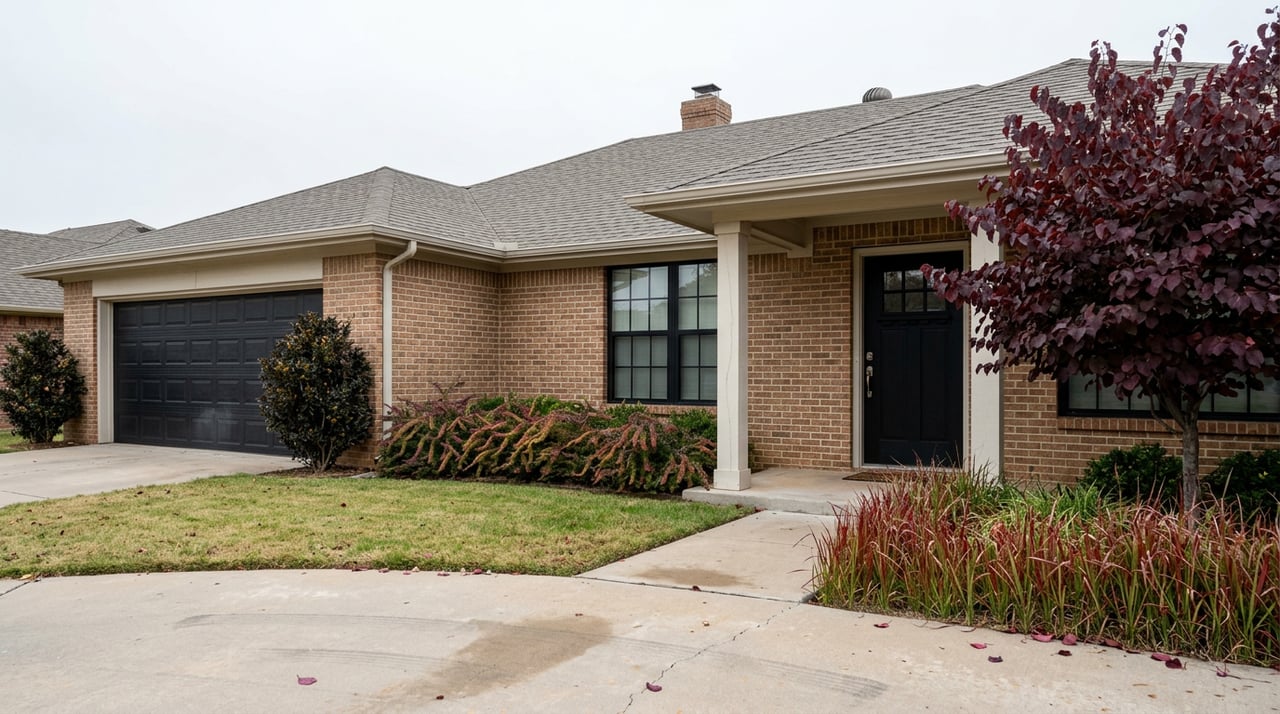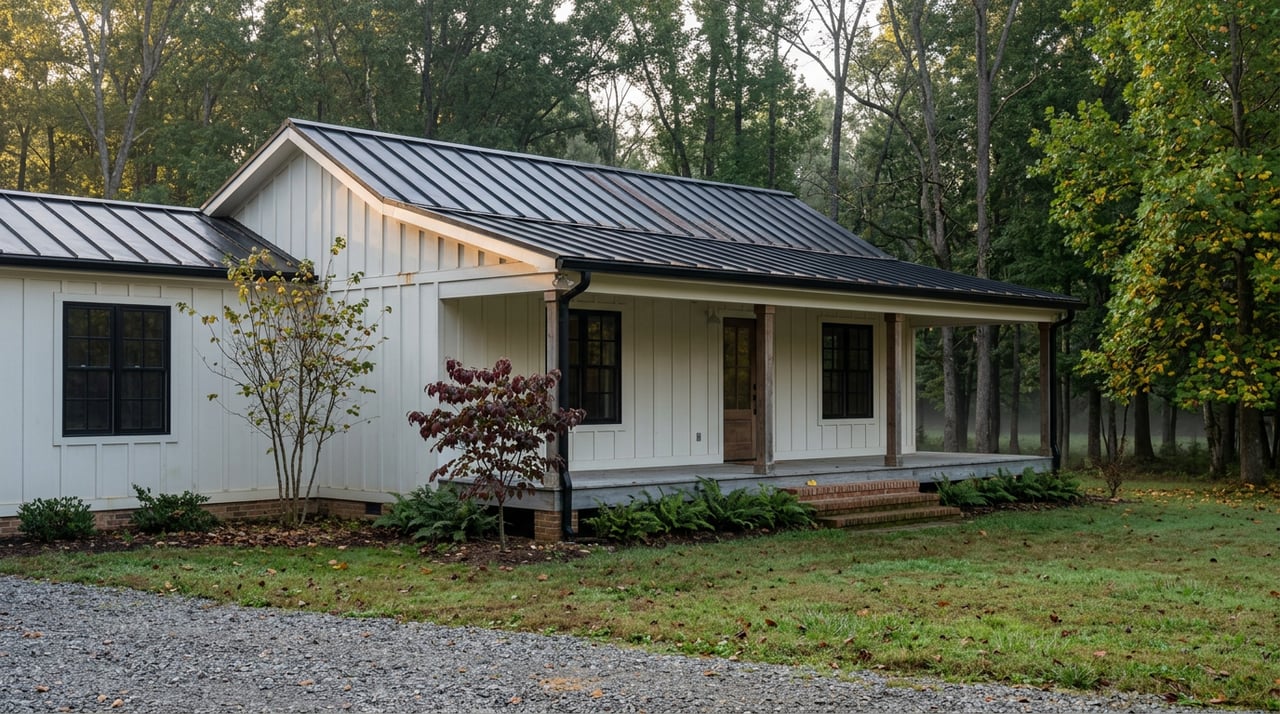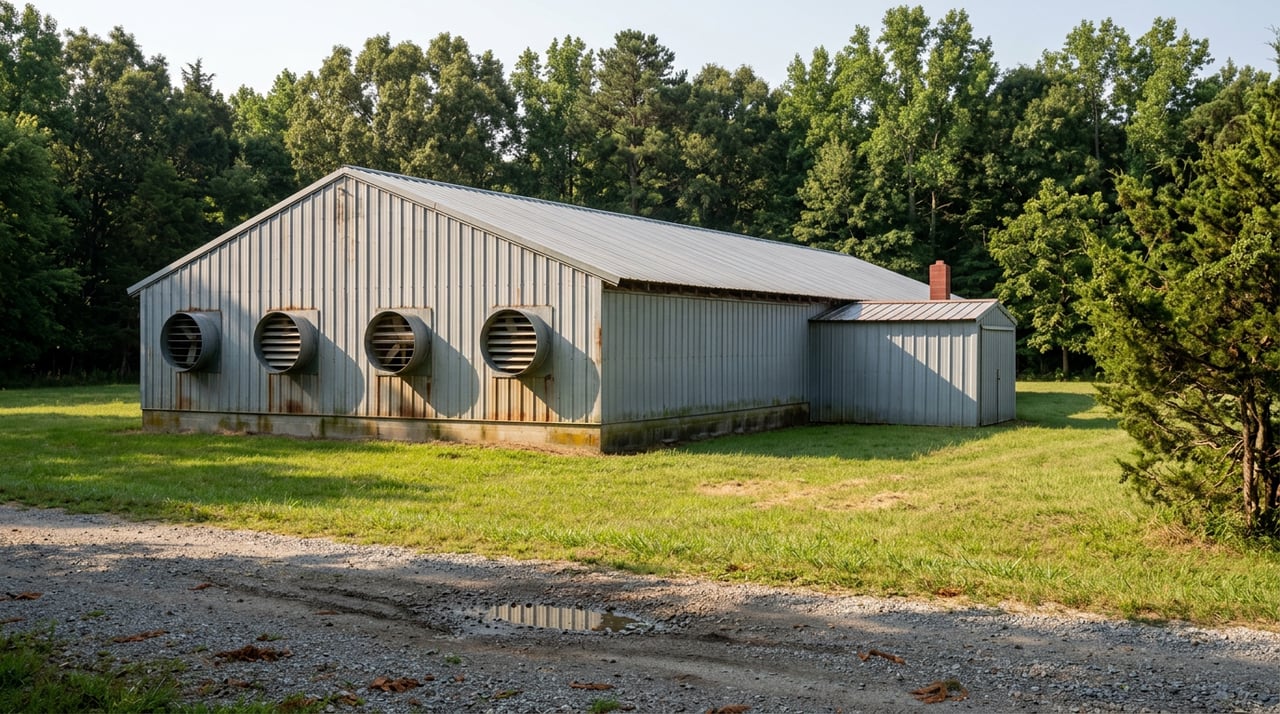
Two properties near Boaz, both selling for their poultry infrastructure, tell almost opposite stories about the same fifteen or so acres of Marshall County dirt. One prices out below what raw pastureland fetches in this county. The other prices out at nearly five times that. Same rolling ground, same climate, same distance from town. The gap isn't the soil. It's a piece of paper neither buyer will ever see hanging on the wall of the farmhouse.
That piece of paper is the integrator contract, and once you understand how it works, you start reading every poultry farm listing in Marshall County differently.
The Same County, Three Different Price Tags
Marshall County land in general lists for somewhere around $39,000 an acre, based on current land listings tracked across the county. A poultry farm here, one with working broiler or breeder houses, has recently averaged closer to $103,000 an acre, based on chicken-farm listings tracked for the county. That's not a small premium. It's close to triple.
But averages hide the more useful story, which is the spread between individual farms. Look at what's actually listed right now around Boaz:
| Farm | Acres | Price | Price per acre | Contract status |
|---|---|---|---|---|
| Crosson Broiler Farm | 15 | $349,000 | ~$23,267 | Houses built 1994; last contracted with Pilgrim's Guntersville; not currently in production, needs upgrades |
| S/S Broiler Farm | 40 | $1,250,000 | ~$31,250 | Five houses; gross income of $280,000 in 2023 |
| Maples Broiler Farm | 41 | $1,600,000 | ~$39,024 | Active Koch Foods Gadsden Complex contract; gross income expected at $300,000-plus |
| Mud Creek Broiler Farm | 45 | $2,550,000 | ~$56,667 | Eight houses, brick home, pond; sale currently pending |
| John and Joel Breeder Farm | 12.5 | ~$1,390,000 | ~$111,200 | Active Koch Foods contract; $384,000 gross income in 2024 |
Crosson has four houses standing on fifteen acres. John and Joel has four houses on twelve and a half acres. Both are within a short drive of Boaz. One sells for roughly $23,000 an acre. The other sells for nearly five times that. The difference isn't the buildings. Crosson's listing says the farm was "most recently contracted" with Pilgrim's Guntersville, which is a polite way of saying the relationship has ended and the houses currently sit empty, needing upgrades before anyone will place chicks in them again. John and Joel's listing leads with a documented $384,000 in gross income for 2024 under an active Koch Foods contract.
The houses are nearly identical assets. The income streams are not. And in this niche, the income stream is the asset.
The Real Collateral Isn't the Dirt
Commercial poultry loans work differently than almost any other agricultural lending product, and the mechanism explains everything about how these farms get priced.
When a lender finances a broiler or breeder operation, they don't just take a mortgage on the land and buildings. They put an assignment agreement in place, a three-way arrangement between the grower, the lender, and the integrator. Alabama Farm Credit describes the structure plainly: the integrator sends a portion of each flock's settlement payment directly to the lender, and that arrangement is signed by all three parties at loan origination. The Alabama Cooperative Extension System puts a number on how much of the farm's income this typically consumes: 45 to 50 percent of gross revenue goes toward the loan payment in a normal year, and that share climbs past 50 percent for a buyer who comes in with less than 20 percent equity.
What this means in practice is that the lender's real security isn't the acreage. It's the reliability of the integrator's payment. A farm with a current, well-performing contract behind it is financeable at scale because the income is close to guaranteed by a company like Tyson, Koch Foods, or Pilgrim's Pride cutting a check on a predictable schedule. A farm without that contract is, from a lender's perspective, just a set of specialized agricultural buildings on a chunk of land, which is a much harder thing to underwrite for millions of dollars.
That's why every serious poultry farm listing leads with gross income and the name of the integrator rather than lot dimensions. It's also why a buyer evaluating one of these properties needs to think less like a land buyer and more like someone underwriting a leased commercial building. The contract is the lease. The integrator is the tenant. The houses are just the shell.
Tier Status Is a Countdown Clock, Not a Feature
One active Boaz-area listing describes its houses as "tier 1" and notes that "with a few updates" they can become "tier 2." Integrators periodically update the technical standards they require of grow-out houses, covering things like ventilation systems, square footage per bird, and cooling capacity, and a farm's tier rating determines how long the current integrator relationship is likely to continue.
A farm rated below current standards isn't necessarily worthless. It's a farm on a timer. The integrator keeps placing flocks there for now, but the next equipment cycle or the next contract renewal may require capital the seller never spent. Buying a tier 1 farm without budgeting for the tier 2 upgrade is buying a shorter runway than the sale price implies.
Crosson Broiler Farm shows what the runway looks like after it ends. The houses are still standing, built in 1994, still on their original fifteen acres. What's gone is the paying relationship. The listing doesn't hide it: upgrades are needed to put the farm back in production. And the price, at roughly $23,000 an acre, sits below what general Marshall County land trades for. The one thing that made a poultry farm worth more than a comparable pasture tract, the active contract, isn't there anymore, so the price falls back toward what the dirt alone is worth.
The Gross Income Number Doesn't Include the Chicken Litter
Even on a farm with a strong, current contract, the advertised gross income figure doesn't capture everything the buyer inherits. Litter and mortality disposal are the grower's responsibility, not the integrator's, under standard state agricultural regulations, and the volumes involved are not small. A single broiler house can generate somewhere between 125 and 150 tons of litter a year, and the standard guidance for spreading that material as fertilizer calls for roughly 35 to 50 acres of land per house.
Run that math against some of the smaller farms in the table above. A four-house operation on fifteen acres doesn't come close to having enough of its own ground to absorb its own litter, which means hauling and off-site disposal arrangements that need to be priced separately from whatever number is printed on the listing sheet. Mortality composting, disposal pits, or incineration equipment carry their own maintenance and inspection requirements as well.
None of this shows up in the $384,000 or $280,000 or $300,000-plus figures that anchor these listings. It's operating cost sitting just outside the frame, and it's one more reason acreage still matters here. It just doesn't matter the way it would on a pasture or timber tract. It matters as disposal capacity, not as a scenic amenity.
What to Actually Check Before You Sign
If you're seriously evaluating one of these properties around Boaz, a few questions matter more than the acre count.
Ask for the Schedule F filings, not just the marketing summary. Extension guidance points lenders toward a three-year Schedule F history precisely because flock timing varies enough that one strong year, like the $384,000 grossed by the John and Joel farm in 2024, doesn't guarantee the same figure repeats going forward.
Confirm the contract is active, not lapsed. Language like "most recently contracted with" in a listing is telling you the relationship has already ended.
Find out the tier rating of the houses and what the integrator would require to renew or upgrade that status over the next contract cycle.
Calculate how much of the property's acreage is actually available for litter application, separate from any homesite, pond, or pasture ground included in the sale.
And talk to a lender who already writes agricultural loans of this kind before assuming the deal pencils out. The assignment structure that makes multi-million dollar poultry financing workable is specific to agricultural lenders, not a product a standard residential mortgage broker will recognize.
Questions We Get From First-Time Farm Buyers
Does the integrator contract transfer automatically when the farm sells? Not exactly. The agreement sits between the grower and the integrator, not between the integrator and the land itself, so a buyer typically needs to be approved by the integrator and put a new assignment agreement in place with their own lender before flocks resume. Confirm this directly with the integrator's local complex rather than assuming it from the listing.
Can a regular home mortgage finance one of these? No. Poultry operations run through agricultural lenders because of the assignment structure described above. Terms are built around flock cycles and settlement payments, not a standard 30-year residential schedule.
Is a farm without a current contract still worth considering? It depends on your plan. Crosson Broiler Farm shows that houses without an active integrator relationship price closer to raw land value, which can be an opening if your intent is to invest in upgrades and pursue a new contract, or to repurpose the acreage for something else entirely.
If you're weighing a poultry farm, a piece of raw acreage, or anything in between around Boaz and the rest of Marshall County, it helps to have someone who reads these listings the way a lender would, not just the way a land ad wants you to. Jeri Franks has spent years working residential, land, and investment property across North Alabama, including the fine print that determines what a property is actually worth. Let's connect before you make an offer on one of these.